





Rob Ashton
I didn’t sleep well last Thursday night. The media images of the previous few days had been playing on an endless loop in my mind, so what little rest I did get was fitful.
Not surprisingly, I was not at my best come Friday morning. My self-discipline was low and, as is usual when I’m tired, I craved carbs – an attempt by my Stone Age brain to get me going by filling my stomach with energy-rich foods.
Downward spirals
So it was that, in a moment of weakness, I opened the news app on my phone. I felt a fleeting urge to try to make sense of the incredibly uncertain situation in which we all find ourselves. That momentary feeling had a lasting impact. What I actually found was a whole lot more uncertainty. By the time I closed the app, half an hour later, my day was already on a spiral downwards. Friday was not one of my most productive days.
I’m guessing you have found yourself in a similar situation more than once in the past few months. To say these are uncertain times is an understatement. And in such times, we often turn to the news to make sense of what is around us, just as I did.
Trigger words
The previous time it happened, a few weeks ago, I decided (after a better night’s sleep) to investigate how this constant exposure to the news might be affecting our mental health. It was not the subjects of the news stories that intrigued me but the words used to tell them – especially the words in the headlines.
Last year, while investigating academic research for my book, I’d discovered a paper that graded the most common words in the English language (almost 14,000 of them) by how difficult they are to ignore and by their emotional impact. So I was intrigued to find out how the media’s use of these ‘trigger’ words has changed this year compared with in previous years.
[bctt tweet=”‘Seeing highly emotive words day in, day out takes a toll. Checking the news compulsively rarely makes us feel better.’ New research on media use of trigger words, from @Robert_Ashton @EmphasisWriting”]
What I found shocked even me. The use of some of these words has increased by a factor of four or five this year. These are words that our brains can’t help but respond to. So the cumulative effect of consuming them amounts to a daily assault that is bound to have a huge impact on our mental health.
Impossible to ignore
The graph below is a good example. The word ‘panic’ is in the top 1.4% of the most emotive words in the English language. It’s impossible to ignore and research shows that it automatically creates anxious feelings when we see it.
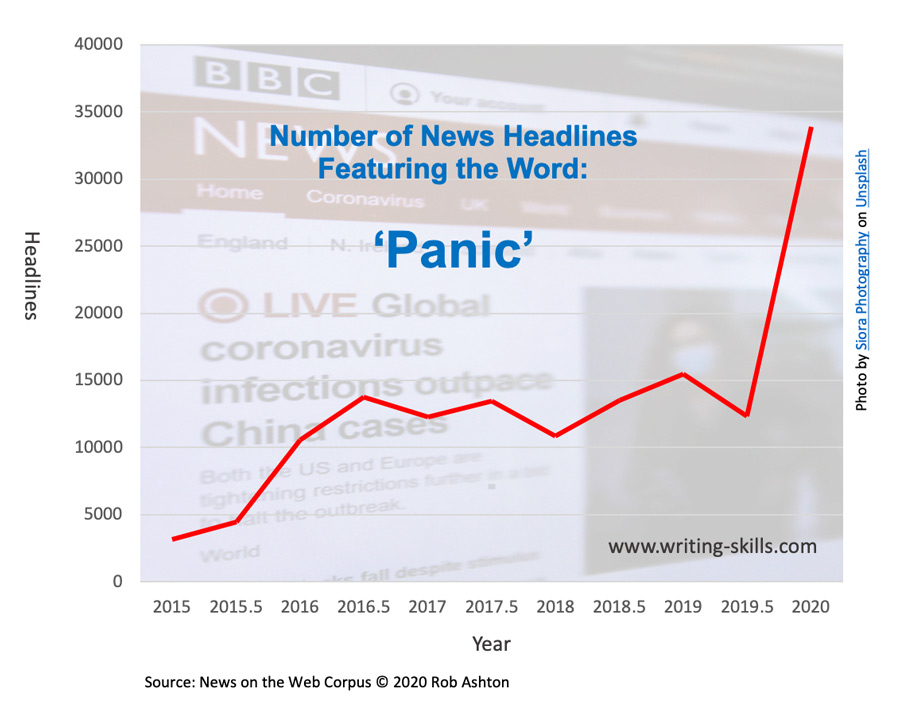
I looked at 12 words in total. The use of all except one had gone up dramatically.
I believe this is something that we all need to take more notice of. So I’ve published a full account of my research results here on LinkedIn.
The anxiety effect
Clearly, we need to check the news. At times like this, it’s important to get the facts and to think carefully about the issues that are affecting all of us. But I also strongly believe that, too often, we sleepwalk from one emotive news story to another. As we do so, our anxiety levels increase, and that anxiety affects all our decisions, not just the ones that relate directly to what we’re reading. If we’re not careful, we end up so focused on things we can’t control that we fail to control the things we can.
Seeing highly emotive words day in, day out takes a toll. Checking the news compulsively rarely makes us feel better.
Words matter. They have consequences. So remember, no matter how anxious or uncertain you feel, the answer is probably not on your phone.

Subscribe
Expert advice to your inbox