




Business report writing
Advice and resources to help you plan and write professional reports that do the job
Contents
Featured

Presenting data
Dazzling with data: how to create charts that win friends and influence people

Effective risk reporting
Dangerous business: how to get risk reports right

Lead your team
How to brief your team to write the report you need

Insider insights
What your boss doesn’t want from your report

Tell your company's story
How to write an outstanding annual report

Fundamentals
So you have to write a business report: an essential how-to

Fundamentals
How to structure a business report
All articles
Dazzling with data: how to create charts that win friends and influence people
Dangerous business: how to get risk reports right
How to brief your team to write the report you need
What your boss doesn’t want from your report
How to write an outstanding annual report
So you have to write a business report: an essential how-to
How to structure a business report

Turn your expert analysis into exceptional reports [webinar recording]

Better consulting reports in 10 steps

Why a list of bullets is not a report (and military writing could make you enemies)

How to conclude a report – like a rock star

Make your reports irresistibly interesting

Can you use the first person pronouns ‘I’ and ‘we’ in a report?

Writing a report for the board? Here’s what you need to know
How to write an executive summary for your board report – and why you should [with examples]
Quick questions
For those answers that don't need a full article
You may not need to include one if your report is very short (like a one- or two-pager). If you're not sure, you can double-check with the person who requested the report whether they would like you to include the summary or not.
But any report over four pages will definitely benefit from an executive summary. A well-written summary can draw readers into the rest of your document.
Although they're often treated as an afterthought, executive summaries are very important documents in their own right. They need to be able to act as a gateway into the full document – or even a replacement for it, for the very busy reader.
Indeed, they are tough to write exactly because they need to be short! They should contain only the most crucial information (and nothing that doesn't also feature in the full report).
Knowing why they need the report is key: what purpose does it need to serve? Is it to inform, to recommend, to update? What level of detail do they need? Who will be the final audience(s) for the report? (And know that there is nothing wrong with asking these questions! It will allow you to write a report that can do the job it needs to.)
A mind map can help you unlock the information that's already in your mind – and it can be a great way to get unstuck too. The process will also highlight gaps in your current knowledge to ask for more information on or to research.
Different readers are likely to want different things from the document. Some will be ‘helicopter’ readers who want to swoop in, grab the key messages and swoop out again. Others will be detail-focused people who’ll want to know everything they possibly can about the subject. So having clear signposting (like descriptive subheadings) will be especially important in documents with multiple audiences.
Useful resources

Prompting success
The Boardroom Advantage
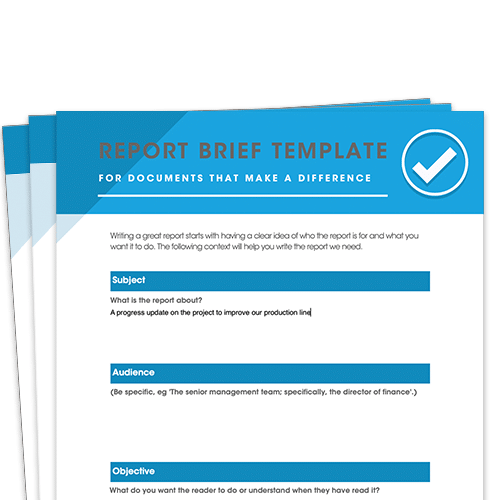
Report briefing template

Proofreading checklist
Case studies
See how we've helped our clients

Bids and proposals, Technical writing
Simplifying technical language and raising communication standards at SeaRoc Group
SeaRoc Group


Business report writing
Making crucial health information accessible for the people who need it
The Health Policy Partnership


Writing to customers
HSBC overhaul complaint-handling style to cut comeback and connect with customers
HSBC


Corporate communications
Tailored treatment means healthier writing at The King’s Fund
The King’s Fund


Business writing essentials, Writing to customers
Demystifying legal speak at Nabarro for a rebrand that sets it apart from the competition
Nabarro


Business report writing, Writing to the board
'We cut the iterations on our strategy documents from 56 to just 4!'
Shawbrook Bank


Business report writing
Turning complex information into impactful research reports at CFE
CFE Research


Business writing essentials
Concise, consistent and contract-winning writing at Spinning Clock
Spinning Clock


Professional email writing
Small UK charity makes big international impact thanks to clear, convincing communications
Refugee Rights Europe


Technical writing, Writing to customers
Environment Agency cultivates a new public image
Environment Agency