




Rob Ashton
I hope you are well. No, really – I do.
But have you ever noticed how those five words have become the default opener for almost every email? Why do we write that?
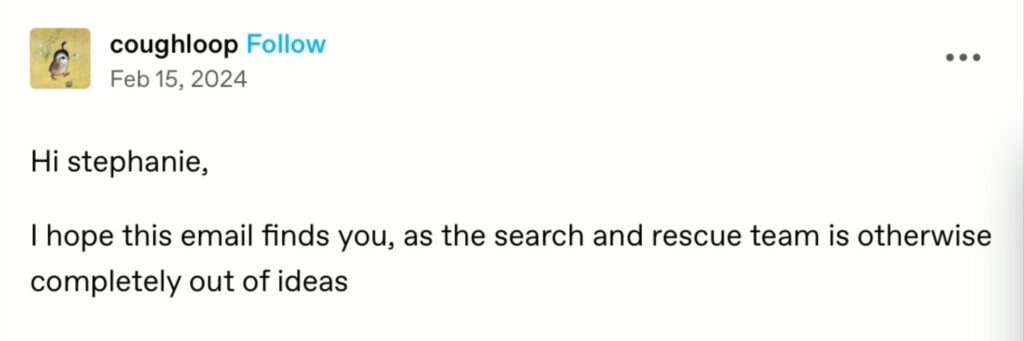
My colleague Catie recently pondered this question on LinkedIn, after seeing a jokey post about it on the social media site Tumblr (below).
As she pointed out, maybe it's time to retire a phrase if it's become worthy of its own meme.
Fresh alternatives
So what's the alternative? Go in cold? That doesn't feel much better.
As I've said many times, professional writing is still supposed to connect one human to another. It may be more efficient – and less clichéd – to get straight down to business. But the recipient may feel a bit miffed if you abandon social niceties altogether – just as they would if you took that approach in person.
Thankfully, there are better ways to start emails without falling back on hackneyed phrases that we all ignore.
Catie suggests several alternatives that feel more genuine:
- 'I hope your presentation went well yesterday'
- 'Thanks for your help with X last week'
- 'I enjoyed our conversation about Y'
These openers do double duty – they acknowledge the recipient personally while smoothly transitioning to the matter at hand.
A ritual or a relic?
Personally, I'm on the fence about 'I hope you're well'. Yes, it's a cliché. Yet it's also a ritual – like asking 'How are you?' (or 'How do you do?') as a greeting in real life. It's meant to relax and prime the recipient.
Then again, 'How do you do?' has become so ritualised that most people just hear it as 'Hello'. I suspect we disregard 'I hope you're well' in the same way.
The real challenge
What you're really trying to do with any opener is help the reader transition from whatever they were thinking about before they opened your message. The challenge is finding words that ease them into what you have to say.
The problem with clichés is that your reader's brain won't even register them. Or worse, they'll be irritated by what sounds disingenuous. This touches on the larger issue of residual attention – how much mental focus your reader can redirect to your message.
The science of attention
As the neuroscientist Daniel Levitin explains in his book The Organized Mind, our brains have limited attentional resources. And switching between tasks depletes these resources rapidly. So when your reader opens your email, they're carrying the cognitive residue of whatever they were doing before – their attentional filter is still partially engaged elsewhere.
It’s essential that they’re able to clear their head of whatever they were reading or doing before if they’re to read your message properly.
I doubt 'I hope this email finds you well' helps with that transition anymore. Far better to remind them of a previous conversation or even to start with a micro-story. That's much more likely to help them switch to the right mindset for your message.
Subscribe
Expert advice to your inbox