






Gary Woodward
With a host of new AI tools at our disposal, applying for a job has never been easier. At the same time, candidates are finding it harder than ever to land a new position. Yes, the job market is tough. But could the way you’re using AI be harming your chances?
If you don’t like writing, AI appears to be a godsend. With a few prompts and a click, you can produce a polished CV, cover letter or LinkedIn profile in minutes. It looks good. It sounds professional.
But the chances are it doesn’t look or sound all that different from everyone else’s. We’re now in a tricky situation: applications look better than ever but say less of real substance. Everyone sounds capable. Very few people sound genuine. And almost nobody stands out.
At the same time, recruiters are dealing with a flood of submissions – often hundreds for a single role. To cope, many hiring managers are using AI to sift, rank and shortlist. So while you’re using AI to write your application, they’re using it to filter you out.
Inside the mind of a recruiter
Some of this isn’t new. Recruiters have always been on the look-out for generic-sounding applications as a way of shortlisting. For quite a while, they’ve used some version of an applicant tracking system (ATS), such as Workday.
This is software which creates a database that ranks candidates by scanning CVs for keywords, skills and experience. This allows recruiters to efficiently handle high volumes of applicants. And many recruiters are using both an ATS and other AI tools to do more of the sorting and ranking.
Where does that leave you? How do you stand out in a sea of apparent perfection? Well, to give you a headstart, I’m going to share some tips from my combined experience in career development and business writing to help you navigate this new world we’re all facing.
1. Make your CV ATS friendly
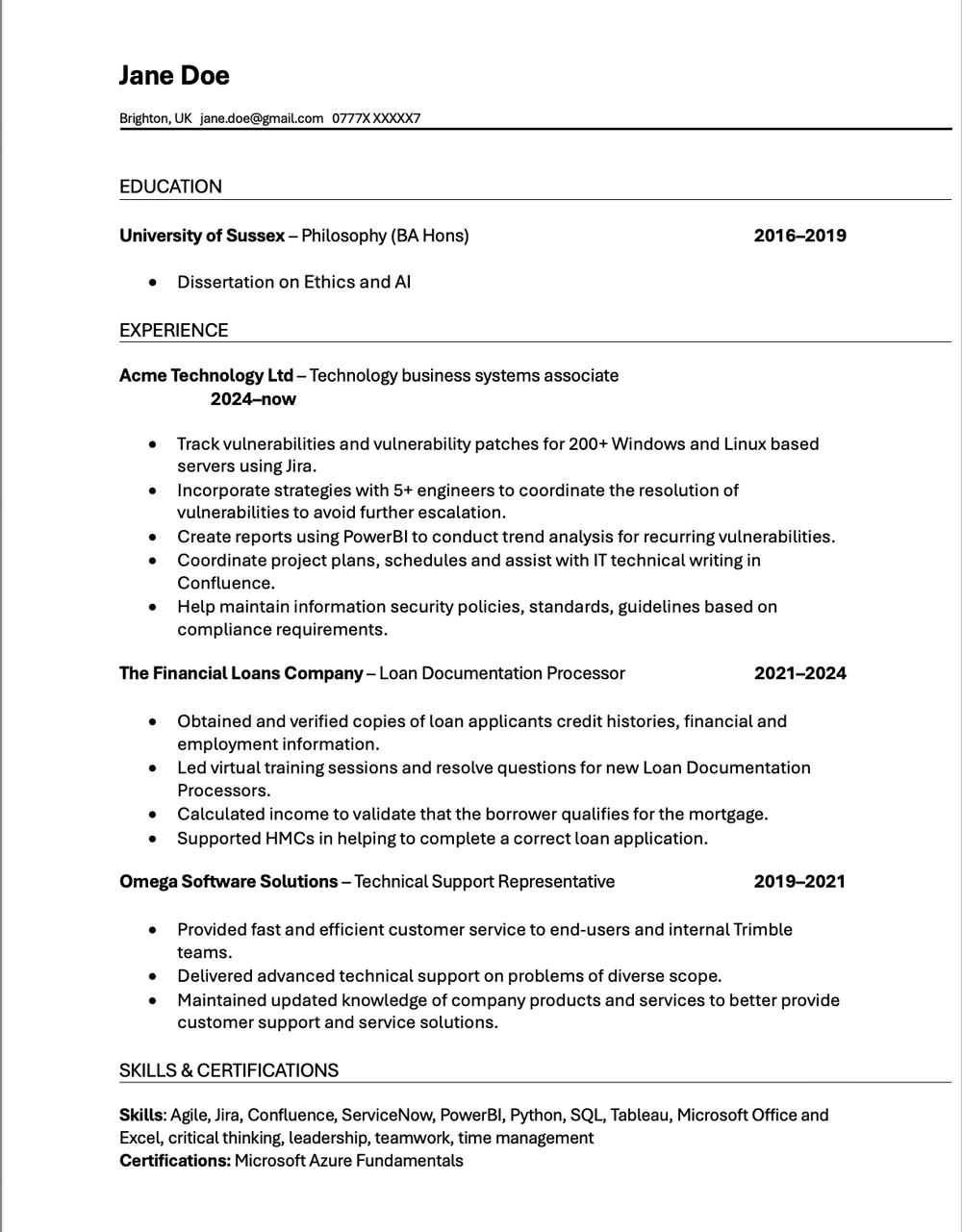
You might be using AI to tailor your CV. But is it ATS friendly? Being creative with your CV by adding some nice design touches, a splash of colour and maybe some columns could work for smaller companies not using an ATS. But for large companies, this could backfire: these elements make it harder for the ATS to ‘read’ your CV. So follow these guidelines to avoid the ATS trap:
- Make sure your CV is high resolution (check, for example, any images or logos aren’t blurry).
- Avoid columns, graphics and colours (an ATS immediately converts your CV to greyscale and aligns everything to the left).
- Use clear, simple headings and sans serif fonts throughout. (Sans serif fonts are the plainer fonts without the twiddly bits at the ends of characters. Think Calibri or Arial not Times New Roman.)
- Make it a Word document, not a PDF. (This one often comes as a surprise! But Word docs are easier for an ATS to process.)
Below is an example of an ATS-friendly CV, from a design perspective only. Of course, you’d have to change the content to make sure it’s relevant to the job you’re applying for. (You can also download the CV here.)
2. Make fewer, high-quality applications
It’s so tempting to use the power of AI to make hundreds of applications in the blink of an eye. This doesn’t generally work well, as your applications tend to become generic and devoid of personality. And it’s important to remember that most recruiters are still making a personal judgement on final recruitment decisions.
So your application still needs to be human and real. It’s much better to get really honest about the jobs you’re genuinely interested in and focus on those. That natural enthusiasm will shine through in your covering letter and CV, and certainly during any job interviews.
3. Do what most applicants don’t
In their job-hunting efforts, most applicants will send a CV and covering letter or fill in an online application form. And that’s about as far as it goes. But given that AI has improved (or at least standardised) the overall quality of written applications, you have to do something different to stand out. Here are a few things to try that most people don’t do:
- Take any opportunity to have an informal chat about the role before you apply. You’ll gain valuable information to make your CV resonate. On LinkedIn, connect with recruiters or people working in the company to see whether they’d give you ten minutes for a chat about the industry.
- Join any industry associations or trade bodies for networking opportunities.
- Analyse any publicly available documents to work out what’s important to the organisation (eg strategic plans, vision documents or mission statements).
- Use your own network to do some sector research.
- Try to get feedback if your CV isn’t getting traction (not always easy).
Danny Wilkey is a senior careers consultant at King’s College Business School in London. He gives this advice to job-seekers in today’s AI context:
‘Do everything you can to ‘get under the skin’ of the jobs you’re interested in. Go to any industry events, and use any contacts you have to speak to people who work in that industry. Find out what makes them tick, what the job really involves, and what values are important for the particular organisation. If you do that, you’ll have some fresh, unique insights to put in your cover letter and some good ideas for tailoring your CV effectively. Your application will resonate much more with the recruiters than something that’s purely been written by AI.’
4. Convince them that your achievements are real
These days, it’s harder for recruiters to see the real person behind the CV, because so many applications look good on the surface (thanks to AI). So what’s going to be more valuable now and in the future is showcasing something that can’t be faked, something concrete that reassures a recruiter.
This could mean including references like we used to do in the past. Or it could be linking to a live project or a portfolio of work, if relevant. It could also mean adding some personality to your LinkedIn profile by creating some posts or short videos. It’s also a good idea to have some testimonials on your LinkedIn profile.
5. Make your applications human
As the saying goes, ‘Nobody’s perfect’. Of course you want to project a good impression of yourself, but it can also work in your favour to mention any areas you want to improve. You could do this in your covering letter, for example: ‘My key strengths are …. One area I’d like to improve in is ….’ The crucial thing is to only choose areas of weakness that are not central to the job you’re applying for! Also note how you plan to actively work to combat them when you’re in the role.
Again, put yourself in the shoes of the recruiter: they’re tired of seeing apparently perfect people who have no areas for growth. Hiring managers are on the look-out for the genuine, the human and the real.
Finally, use natural language and straightforward words. Yes, it’s a good idea to repeat some of the skills they’re looking for to satisfy the ATS. But steer clear of jargon. Use ‘you’ and ‘your’ where possible, rather than the name of the organisation: so, ‘I’d be delighted to join your team,’ rather than ‘I’d be delighted to join the team at XXX.’
The AI opportunity
AI isn’t going anywhere. If anything, it’s becoming a standard part of the job application process – for you and for hiring managers. But that doesn’t mean the process has to become cold and robotic.
Recruiters are still looking for something human when it comes to making decisions. They want to understand who you are, what genuinely interests you and whether you’ve taken the time to understand the role you’re applying for.
And that’s the opportunity. So by all means, use AI. It’s a powerful tool. Just don’t let it do all the talking. In a world of polished, automated applications, the ones that feel real are the ones that get remembered.
Image credit: PeopleImages / Shutterstock
Subscribe
Expert advice to your inbox