





Catie Holdridge
The English language is littered with grey areas and apparent paradoxes that cause confusion.
One of our former delegates, Richard, got in touch to ask our advice on just such a troublesome topic.
Hello Emphasis
What do you think of this sentence? ‘We need to balance the need for security with the ability of the public to continue with their day-to-day lives.’
Is it incorrect? After all, the public is a singular entity, yet here they continue with their plural lives. But then, how can the public have a singular life? On the other hand, members of the public can live their lives with numerical consistency! I welcome your thoughts.
Richard
What Richard’s getting at here is that this sentence seems to mix up a singular word (‘public’) with plurals (‘their’ and ‘lives’) – a grammatical no-no. But is that what’s happening here? Is public singular or plural? In other words, should you write public is or public are?
Confusing collectives
Public is an example of something called a collective noun: a word that denotes a single thing made up of multiple constituent parts. There are lots of other collective nouns, including committee, team, audience and government.
Given that collective nouns are miraculously both singular and plural at the same time, it’s little wonder that we get confused or find inconsistencies in the verbs, pronouns and even nouns assigned to them. The only easy answer comes where the collective noun refers to a collection of inanimate objects, such as cutlery or luggage – these we can always treat as singular.
British v American English
But when the constituent parts of a collective noun are living it gets a bit more complicated. What the ‘right’ answer is depends on context and – to an extent – who is doing the writing (or speaking).
British English tends to see either a plural or singular verb, pronoun or noun as acceptable, depending on the context in which the collective noun is used. American English, however, is considerably more rigid in sticking with the singular. Though they too may reconsider occasionally, based on context.
It’s all in the context
The context we’re talking about here is the sense that the collective noun has in the sentence. Namely, does it suggest a group made up of individuals behaving independently or one acting or viewed as a unit? If the former, then we can give it a plural verb; if the latter, we’ll treat it as singular. So, for example, we might have:
The Government has passed the new law [singular]
but
The Government are debating the matter [plural – it’s hard to debate by yourself].
And
The committee is now in place
yet
The committee are planning to share their findings tomorrow.
If in doubt, look it up
Different publications and organisations may define their own style choices on how to treat collective nouns – most likely to avoid spending precious time on debate every time the word’s needed. The Economist, for example, directly covers as many bases as possible for the benefit of its team of writers (and anyone else who’s interested). The Guardian, meanwhile, has a looser, more succinct and less prescriptive approach in its style guide’s entry on collective nouns.
If in doubt, check in a dictionary to see whether a word should be treated one way or the other. Sometimes there is a more black-and-white answer: ‘police’, for example, should always be plural. (Inevitably, though, it isn’t treated this way with utter consistency.)
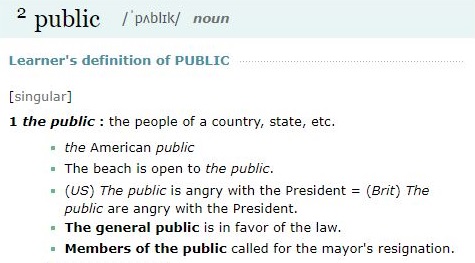
So if we check an American dictionary (Merriam-Webster), we find public listed as singular, with only singular examples. You’ll also see the entry has a usage note pointing out British English’s leaning towards the plural:
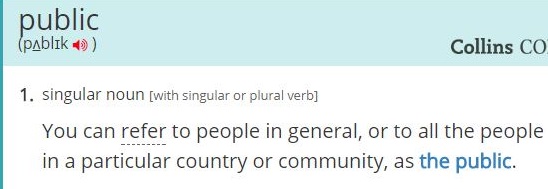
Meanwhile, the entry in our British dictionary of choice (Collins) states that the word can indeed take either a singular or a plural form:
The verdict
So either public is or public are can be correct, depending on context. And, for Richard, we can conclude that a sentence like his is indeed acceptable (at least in the UK, where we are). Yes, ‘the public’ is a singular entity, but it is made up of many and varied individuals, whose lives are certainly not proceeding as one.
As always, the key is being consistent. Avoid treating a collective noun as both singular and plural within the same sentence, paragraph or piece. For example:
If the public chooses to give up these rights, they must accept that their lives will inevitably change. X
In this sentence we’ve slipped from a singular verb (‘chooses’) to plural pronouns (‘they’, ‘their’) and multiple lives, which is absolutely incorrect.
As Richard notes, you could avoid the matter by referring to something like ‘members of’ the public (or of the committee, government etc) or you could replace ‘public’ with a word such as ‘people’. This shouldn’t be vital if we’re careful with consistency, but it’s a handy alternative if you’re writing for an American-English audience or one with strict style rules on the matter.
Image credit: Montri Thipsorn / Shutterstock

Subscribe
Expert advice to your inbox